

Borden Bridge
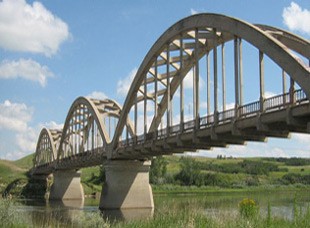
The Borden Bridge is a historic concrete bowstring-arch bridge spanning the North Saskatchewan River, located just east of the Village of Borden along Highway 16. Originally known as the Ceepee Bridge, it remains one of Saskatchewan’s most recognizable Depression-era engineering landmarks.
History & Construction
Construction of the bridge took place between 1935 and 1937 as a Depression-era make-work project, replacing an earlier ferry crossing. The bridge officially opened in 1937.
The structure was built by R. J. Arrand Company of Saskatoon and designed by Bev Evans as part of his master’s thesis while a graduate student at the University of Saskatchewan. At approximately 250 metres in length, it was the longest concrete bowstring-arch bridge in North America at the time of its completion.
The project was deliberately labour-intensive to maximize employment during the Great Depression. Workers were paid 35 cents per hour, or 50 cents per hour if they supplied a horse, reflecting the economic realities of the era and the importance of the project to local livelihoods.
Closure & Replacement
In 1985, the original Borden Bridge was closed to vehicular traffic following the construction of a new dual-lane bridge immediately to the north, built to accommodate modern traffic volumes along Highway 16. The original structure was retained as a historic landmark and pedestrian-accessible site.
The bridge was later sold to Orville Middleton in 2007.
Community & Cultural Significance
Today, the Borden Bridge remains a cherished local landmark. The surrounding riverbanks are popular throughout spring, summer, and fall for fishing, relaxing, and enjoying scenic views of the river valley. The bridge and its setting are also a favourite backdrop for photographs, including graduation photos, wedding portraits, and family pictures, marking important milestones for residents and visitors alike.
Media & Documentation
The bridge is featured in the online documentary series Abandoned Saskatchewan, https://youtu.be/vodIzwb7rQI, which highlights historically significant structures across the province and documents the bridge’s enduring presence in the landscape.